
Most construction companies do not struggle because of a lack of work.
They struggle because they cannot predict where the next job is coming from.
Some months feel full. Others feel uncertain. And that inconsistency makes it difficult to plan, hire, or grow with confidence.
The real issue is not demand. It is the absence of a system.
Why Growth Feels Unpredictable
Many construction businesses rely on a mix of referrals, word-of-mouth, and occasional marketing efforts. When things are going well, it feels like the system is working. But when the flow slows down, there is nothing reliable to fall back on.
That is when stress starts to build.
You are beginning to pursue opportunities rather than choose them. You take on projects that are not ideal just to keep things moving. And long-term growth gets replaced with short-term decisions.
Without a predictable system, growth becomes reactive.
The Difference Between Activity and a System
There is a big difference between doing marketing and having a growth system.
Most companies are active. They run ads, update their website, and try different strategies. But those efforts are not connected.
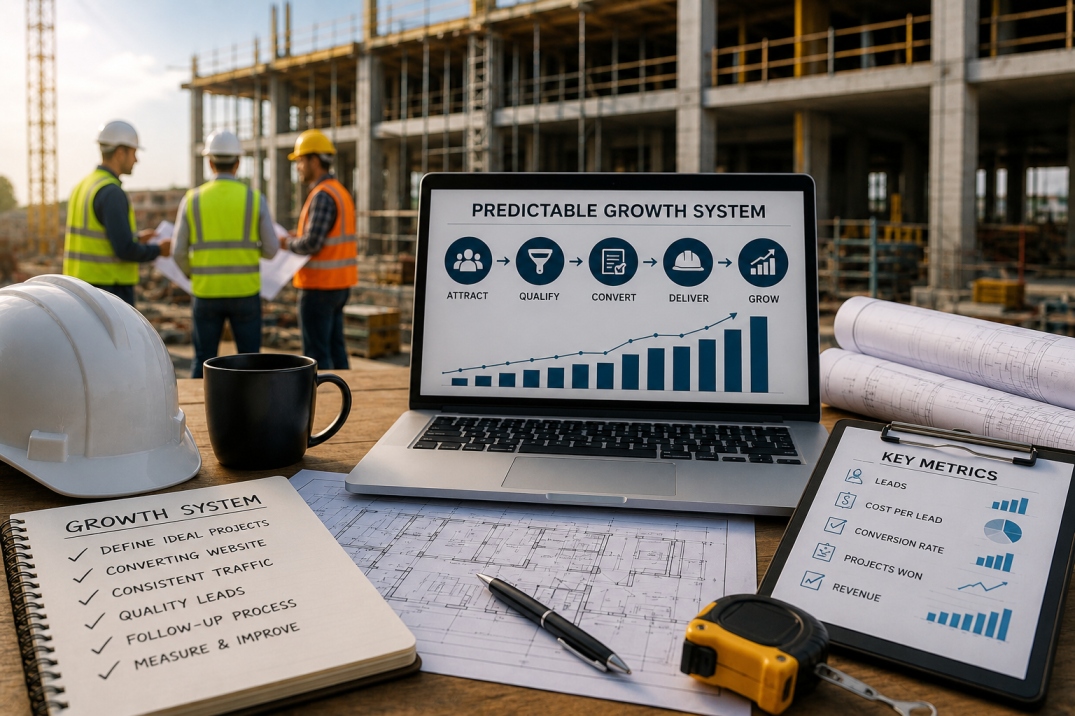
A system is different. It is designed with a clear outcome in mind. Every part of it works together to consistently generate, qualify, and convert leads.
When you have a system, you are not guessing. You are following a process that produces results over time.
Step One: Define the Right Type of Work
Before building anything, you need clarity.
Not all projects are equal. Some are more profitable. Some are easier to manage. Some align better with your long-term goals.
If your marketing is not focused, you will attract a mix of opportunities that do not move your business forward.
A predictable growth system starts by defining exactly what kind of work you want more of. This shapes your messaging, your targeting, and your overall strategy.
Without this step, everything else becomes less effective.
Step Two: Build a Website That Converts
Your website should do more than explain what you do.
It should guide potential clients toward a decision.
Most construction websites are built as digital brochures. They show past projects, list services, and provide contact details. But they do not create a clear path for someone to take the next step.
A strong website communicates value, builds trust, and removes uncertainty. It answers the questions your ideal client is already thinking about and makes it easy for them to reach out.
When your website is designed to convert, it becomes a central part of your growth system.
Step Three: Create Consistent Traffic
Once your foundation is in place, the next step is bringing the right people to it.
Traffic should not be random. It should be intentional.
This can come from multiple sources, including search, paid campaigns, and targeted outreach. The key is not where the traffic comes from, but how well it aligns with your services.
When your traffic is aligned with your ideal projects, your conversion rate improves. You spend less time filtering out poor leads and more time focusing on real opportunities.
Consistency in traffic leads to consistency in results.
Step Four: Improve Lead Quality, Not Just Volume
A predictable system is not built on volume alone.
Many construction companies believe that more leads will solve their problem. But without quality, more leads often create more noise.
Low-quality inquiries slow you down. They take time, reduce efficiency, and make it harder to focus on the right projects.
A better system filters this at the source.
Clear messaging, targeted campaigns, and a structured process ensure that the leads coming in are more aligned with your business. This improves close rates and reduces wasted effort.
Step Five: Build a Reliable Follow-Up Process
Generating leads is only part of the system.
What happens after someone reaches out is just as important.
Many opportunities are lost not because of a lack of interest, but because of slow or inconsistent follow-up. Delays, unclear communication, or missed touchpoints can cause potential clients to move on.
A predictable growth system includes a clear follow-up process. Every inquiry is handled quickly, consistently, and professionally.
This builds trust and increases the likelihood of converting opportunities into actual projects.
Step Six: Measure What Matters
Without tracking, there is no way to improve.
You need to understand where your leads are coming from, how they are converting, and which efforts are driving real results.
This does not require complex systems. It requires clarity.
When you know what is working, you can invest more into it. When something is underperforming, you can adjust it before it becomes a larger issue.
Measurement turns your system into something you can refine over time.
Turning Growth Into a Repeatable Process
When all of these pieces come together, something changes.
Growth stops feeling unpredictable.
Instead of hoping for referrals or waiting for opportunities, you begin to see a steady flow of qualified leads. You understand your numbers. You can plan ahead. And you can scale your business with more confidence.
This is what a predictable growth system does. It replaces uncertainty with structure.
Final Thoughts
Most construction companies do not need more effort. They need better alignment.
A predictable growth system is not built overnight, but once it is in place, it changes how your business operates. It gives you control over your pipeline, improves the quality of your projects, and supports long-term growth.
The difference between inconsistent results and steady growth often comes down to one thing.
Whether you are operating on an activity or on a system.
FAQs
What is a predictable growth system for a construction business?
A predictable growth system for a construction business is a structured process that consistently generates, qualifies, and converts leads. It connects your website, marketing efforts, and follow up into a system that produces reliable results over time.
Why do construction companies struggle to grow consistently?
Many construction companies struggle because they rely on referrals and disconnected marketing efforts. Without a system, their lead flow becomes inconsistent, making it difficult to plan and scale.
How can I build a predictable growth system for my construction business?
You can build a predictable growth system by defining your ideal projects, creating a website that converts, generating targeted traffic, improving lead quality, and implementing a strong follow-up process.
What is the biggest mistake in construction marketing systems?
The biggest mistake is focusing on isolated activities instead of building a connected system. Without alignment, marketing efforts fail to produce consistent and measurable results.
How do you improve lead quality in a construction business?
Lead quality improves when your messaging, targeting, and process are aligned with your ideal client. This filters out unqualified inquiries and brings in more relevant opportunities.
Why is follow-up important in a predictable growth system?
Follow-up is critical because many leads are lost due to delays or poor communication. A structured follow-up process ensures that opportunities are handled properly and increases conversion rates.