
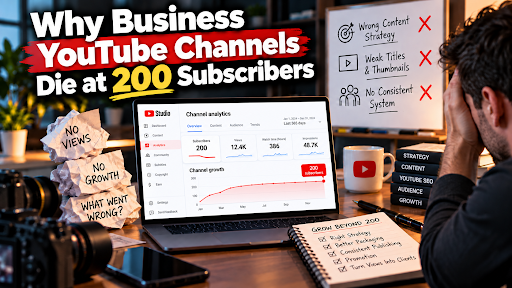
Almost every business channel starts the same way. The first videos go up, the team shares them, customers and friends subscribe, and within a few months the count reaches a couple of hundred. Then it stops. New videos get a few dozen views, the subscriber number barely moves, and a year later the channel is still sitting near 200 with its last upload from the previous spring.
This is not bad luck, and it is rarely about the camera. It is a predictable wall with three causes, and every one of them can be fixed. Here is what is really happening, and how to choose the right way past it.
Why 200 Is Where the Warm Audience Runs Out
Your first couple of hundred subscribers mostly come from people who already know you. Employees, customers, vendors and family subscribe because they like you, not because the videos found them. That audience is valuable, but it is finite, and once it has subscribed, growth depends on something much harder: strangers finding your videos and choosing to watch them.
That is where YouTube’s recommendations take over, and they only help channels whose videos strangers click and keep watching. Nearly every competitor is making video now. Wyzowl’s 2026 survey found that 91% of businesses use video as a marketing tool, so a channel without a clear system gets lost in the pile. The wall at 200 is simply the moment a channel has to earn attention instead of borrowing it.
Killer One: Videos Made for the Company, Not the Viewer
The most common business channel is a scrapbook. Event recaps, ribbon cuttings, product announcements and a reel from the holiday party all make sense to the people inside the company, and none of them give a stranger a reason to click. Nobody searches YouTube for your company news unless they already know your name.
Channels that grow make a clear promise to a specific viewer. A roofing company might answer the questions homeowners ask before replacing a roof, and a nonprofit might show donors exactly what their support changes. Every video either keeps that promise or does not get made, and that single filter does more for growth than any piece of equipment.
Killer Two: Packaging Treated as an Afterthought
Most business videos get their title and thumbnail in the last five minutes before upload, usually the topic name and a frame grabbed from the footage. On YouTube that is backwards, because the title and thumbnail decide whether anyone watches at all. YouTube’s own help center notes that half of all channels and videos have an impressions click-through rate between 2% and 10%, which means most people who see a video never click it.
Small improvements in that number compound quickly. A title that makes a specific promise and a thumbnail that shows it at a glance can double the viewers a video reaches without changing a second of the content. That is why growing channels decide the packaging before they film, then make sure the opening of the video delivers on it right away.
Killer Three: Nobody Owns the System
The third killer is the quietest. The channel gets handed to someone who already has a full-time job, often a marketing coordinator or an office manager, and it survives until the first busy month. Uploads slow down, then stop, and the channel ends up with eleven videos and a two-year gap.
Growth on YouTube comes from repetition: publishing, reviewing what worked and adjusting the next batch. That loop needs an owner with the time and the skills to run it every week, not just someone willing to press record. Most business and nonprofit channels do not stall because the ideas are bad. They stall because nobody runs the system after the camera stops.
DIY, Video Agency or Managed Channel: Which Fixes It?
Doing it yourself costs the least in money and the most in time. It can work well if one person truly owns the channel, learns packaging and YouTube SEO, and has protected hours every week to do the job. It usually fails when that person is also covering three other roles, which describes most small and mid-sized businesses.
Hiring a video production company fixes how the videos look, and that is rarely the problem. You end up with beautiful footage that still has no strategy behind it, no packaging decisions and nobody publishing, promoting or following up with the viewers it attracts. A managed channel covers the whole system, from strategy and filming through thumbnails, publishing, promotion and lead connection. It costs more than doing it yourself, and you still need to show up on camera, but it is the only option that deals with all three killers at once.
How to Get Past the Wall
Start by writing one sentence that describes who the channel is for and what it promises them, then look at your last ten videos and count how many actually keep that promise. Next, rewrite the titles on your three best videos so each one makes a specific promise, and design thumbnails that can be understood on a phone screen in a second.
Finally, commit to a publishing schedule you can keep for six months, and batch-film so a busy week never breaks it. Add a clear next step to every video, whether that is a call, a download or a landing page, so the viewers you earn have somewhere to go. If you would rather have the whole system run for you, our YouTube channel management services exist for exactly this situation, and you can start a conversation to get a free YouTube Growth Plan.
Frequently Asked Questions
How many subscribers does a business channel need to get clients?
Fewer than most people think. A few hundred of the right viewers, such as local homeowners or decision makers in your industry, are worth more than tens of thousands of random ones. Measure the channel by the conversations it starts, not by the subscriber count alone.
How long should we give a channel before deciding it is not working?
Give it at least six months of consistent publishing with the three killers fixed. The first three months are usually the slowest, because YouTube is still learning who your videos are for. Judging a channel after a handful of uploads tells you very little.
Should we buy subscribers to get past 200?
No. Bought subscribers do not watch, comment or become clients, and fake engagement breaks YouTube’s rules, which can put the whole channel at risk. Paid promotion through YouTube ads is different and can work well, but only behind videos that already hold viewers’ attention.
Are Shorts or long videos better for a business channel?
They do different jobs. Shorts are good at putting your name in front of new people quickly, while longer videos build the trust that leads someone to call you. Most growing business channels use Shorts as the doorway and long videos as the destination.
Do we need expensive equipment to grow a channel?
No. A modern phone or a mid-range camera, a decent microphone and good light are enough for most business channels. Viewers forgive average video far more easily than bad audio or a boring opening, so spend your effort on sound, packaging and the first thirty seconds.